
Ceramic Compounds
Fire-performance formulations for cable insulation and sheathing.
View family detailsExplore our portfolio of Ceramic Compounds, E-beam Compounds, and Engineering Polymers. Product selection is based on the carrier resin, processing method, end-use application, and targeted performance requirements, ensuring the most suitable material solution for each application.
Fire-performance formulations for cable insulation and sheathing.
View family detailsMaterial systems developed for electron-beam crosslinking.
View family detailsPE and PP-based compounds for equipment in potentially explosive atmospheres: controlled conductivity, UL 94 V-0 options and a Conductive (ESD) line.
View family detailsMaterial solutions for cable-related electrical applications.
View family detailsCompound solutions for joints, terminations and power cable accessories.
View family detailsFlame-retardant TPU compounds combining fire performance with flexibility, abrasion and tear resistance for demanding cables.
View family detailsOur own special blends: eight additive masterbatches formulated in-house, from anti-dripping and flame retardant to UV, desiccant and antioxidant systems.
View family detailsFR masterbatches tailored for gas pipe and infrastructure applications.
View family detailsAdhesion-promoting systems for improved filler and polymer compatibility.
View family detailsFlexible elastomer systems for demanding cable and industrial performance.
View family detailsCarrier-specific mineral-filled systems for polymer processing.
View family detailsInsulation, sheathing, profile and application-specific PVC systems.
View family detailsAdvanced Ceramic Compound solutions designed to provide reliable protection and performance where high-temperature and fire resistance are critical.
CAB-HFCR/301 · Ceramic-Forming HFFR Compound
The animation follows a standard NYA/NYAF cable sheath compounded with CAB-HFCR/301 through the four stages of ceramification.
32-second animation with music; it starts silently — use the sound button to listen. Illustrative sequence; performance is verified per construction and test standard.
Ceramic Compound is a high-performance material technology developed to help maintain the integrity of cable insulation and sheathing systems under extreme temperatures and fire conditions.
Unlike conventional polymeric materials, which may soften, melt, or lose their mechanical integrity when exposed to high temperatures, Ceramic Compound formulations are designed to form a rigid, ceramic-like protective structure when subjected to intense heat. This protective layer acts as a barrier around the cable, helping to maintain its mechanical and electrical integrity for longer periods during fire exposure.
Our Ceramic Compound solutions can be formulated to provide a combination of high-temperature resistance, flame retardancy, low smoke emission, and halogen-free performance, depending on the specific application and technical requirements.
CAB-HFCR/201 · After flame exposure
Footage of a cable insulated with CAB-HFCR/201 after flame exposure. The burnt surface is scraped away to show what the compound leaves on the conductor.
22-second clip with the original sound; it starts muted — use the sound button to listen. The inset shows the ceramic layer at 2× detail.

Fire performance standard · BS 6387:2013
BS 6387:2013 defines fire-resistance requirements for cables that must keep a circuit alive while they burn. Category CWZ combines its three most demanding protocols, applied in sequence on the same cable.
What this demands from the sheath is the same ceramic-forming behaviour shown in the animation above: the compound chars, converts into a coherent ceramic layer and holds that layer through heat, water and impact. CWZ performance is specified for tunnels, industrial plants, high-rise buildings and emergency or safety circuits.
CAB-HFCR/201 is formulated for cable constructions qualified to BS 6387 CWZ. Circuit integrity is a property of the finished cable and is verified per construction and test protocol.
Request grade-specific technical data and processing guidance for your application.
Higher durability, longer service life, and more reliable cable performance with E-Beam technology.
E-Beam Compounds are high-performance polymer compounds specially developed for cable insulation and sheathing applications that are crosslinked using Electron Beam (E-Beam) technology.
Our E-Beam Compound formulations can be designed for applications requiring high-temperature resistance, mechanical strength, flexibility, abrasion and oil resistance, low deformation, and long-term thermal stability.
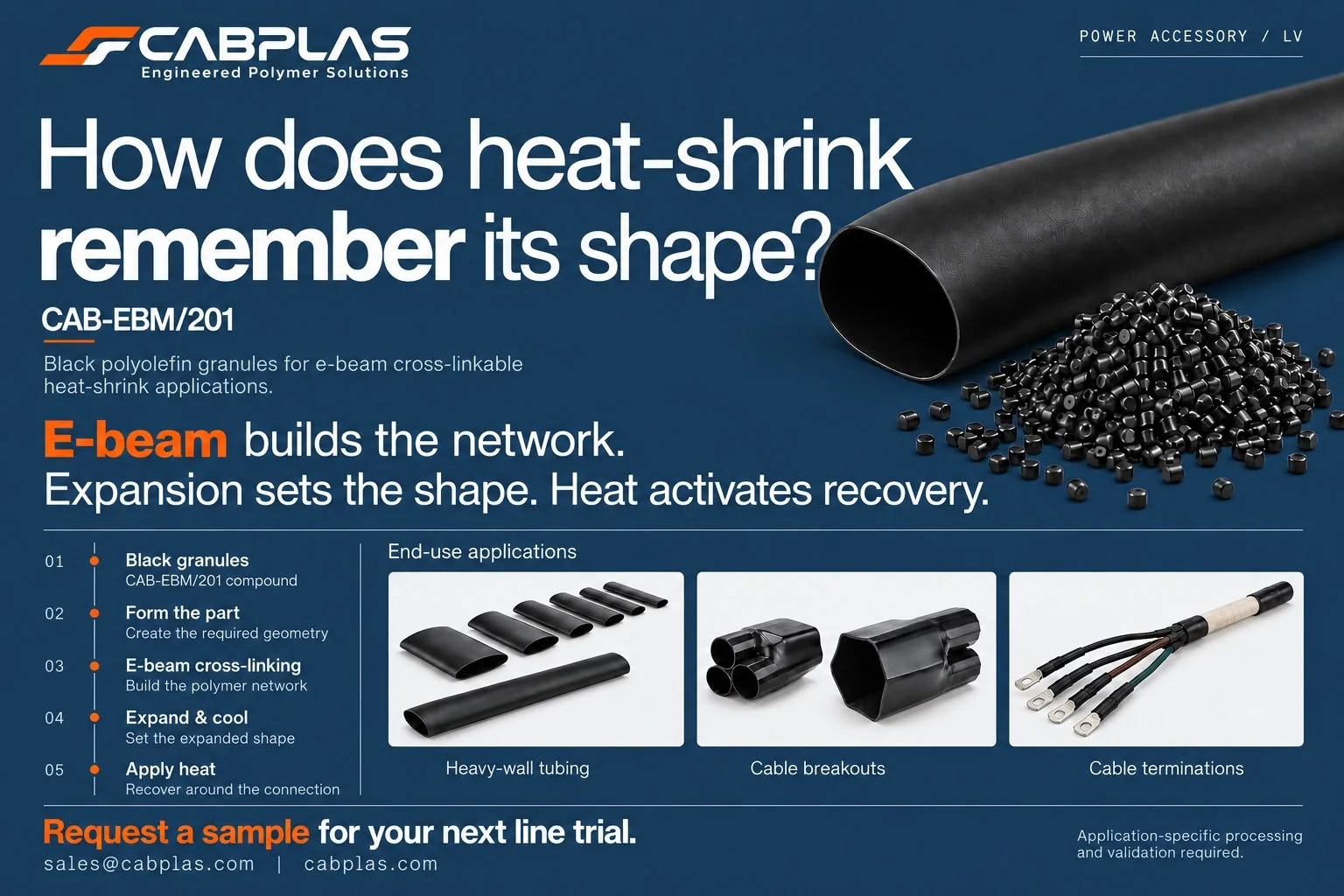
Power Accessory / LV · E-beam cross-linking
CAB-EBM/201 is a black polyolefin compound supplied as granules for e-beam cross-linkable heat-shrink products. E-beam builds the polymer network, expansion sets the shape and heat activates recovery.
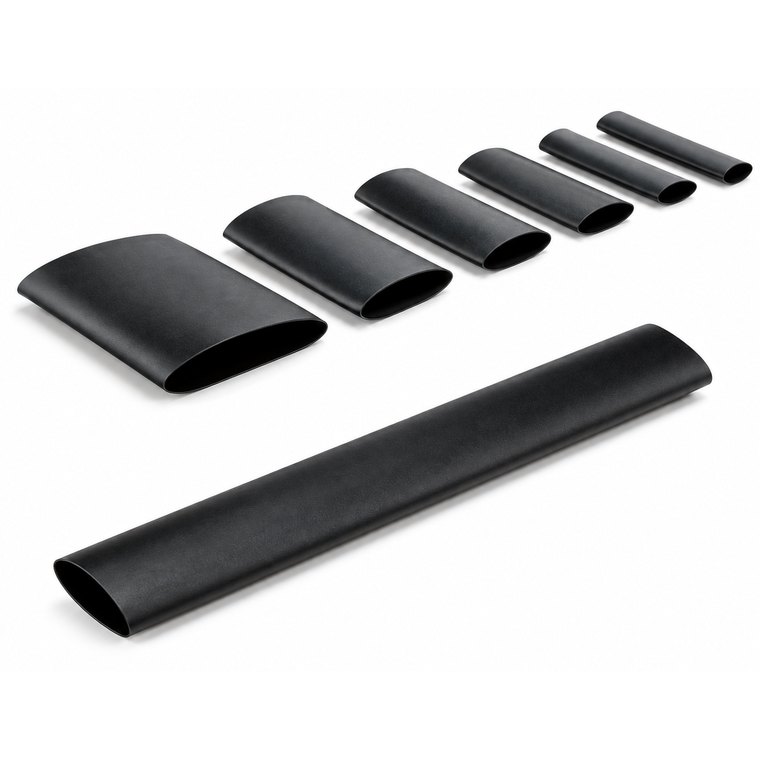
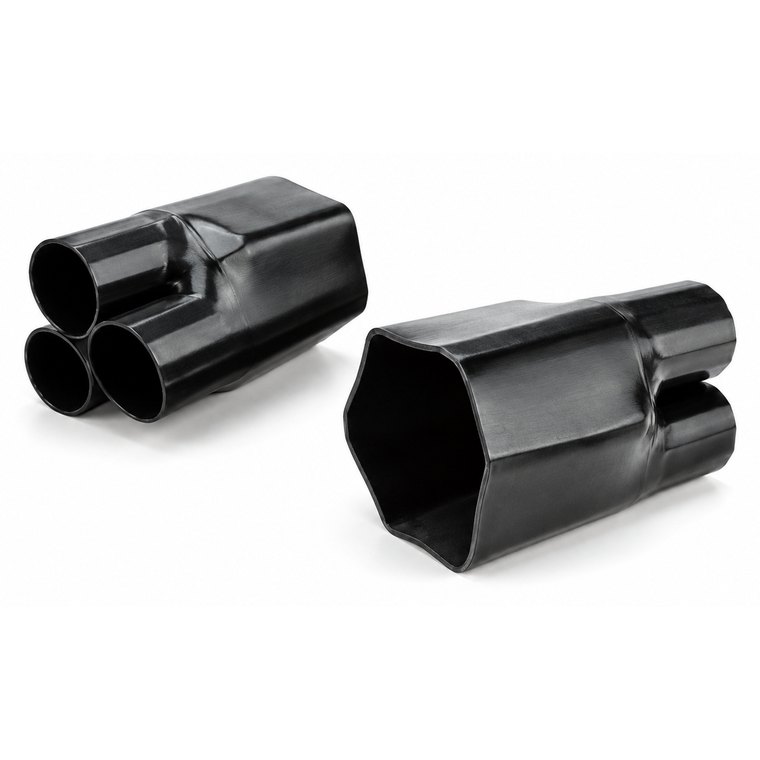
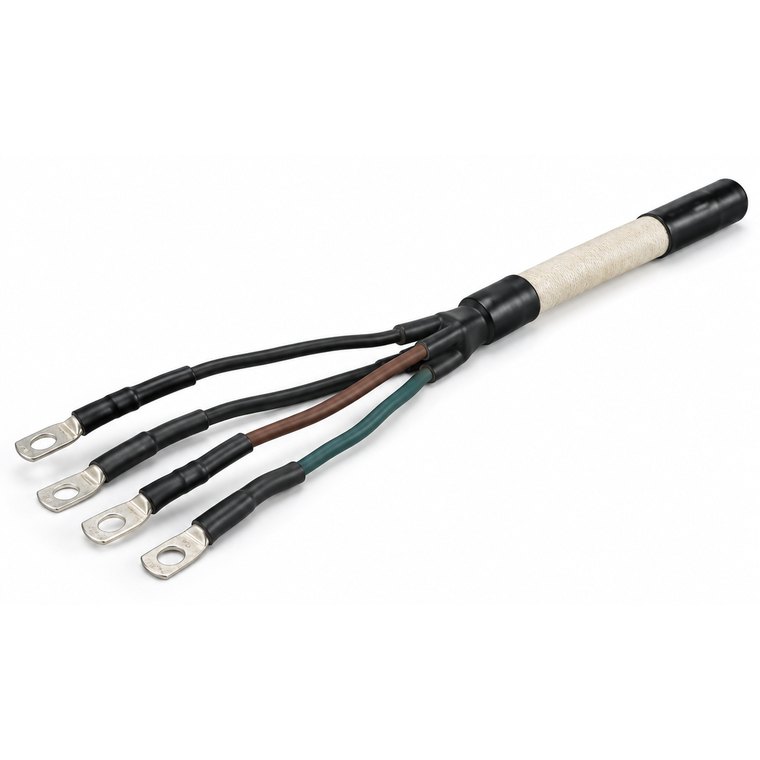
End-use products: heavy-wall tubing, cable breakouts and cable terminations.
Request a sample for your next line trial
Application-specific processing and validation required.
Request grade-specific technical data and processing guidance for your application.
Advanced Flame Retardancy and Electrical Performance for Demanding Environments
High-performance PE and PP-based polymer compounds engineered for controlled electrical conductivity, UL 94 V-0 flame-retardant performance options, and reliable operation in demanding industrial environments.
ATEX Zone Compounds are advanced polymer formulations developed for cable systems, electrical equipment, and specialized plastic components used in industrial environments where potentially explosive atmospheres may occur.
Based on Polyethylene (PE) and Polypropylene (PP) carrier polymers, our formulations are engineered to combine electrical conductivity, flame retardancy, mechanical strength, and thermal stability to meet the demanding requirements of industrial applications.
Designed to achieve surface resistivity values below 106 Ω/sq, our conductive formulations help control electrostatic charge accumulation, supporting applications where static electricity management is critical.
Our specialized formulations can also be developed to target UL 94 V-0 flame-retardant classification, providing enhanced flame-retardant performance for industrial applications requiring additional material safety characteristics.
Suitable for both extrusion and injection molding processes, our compounds offer a combination of mechanical durability, thermal stability, environmental resistance, and consistent processability.

Controlled Electrical Conductivity for Industrial Applications
Advanced PE and PP-based conductive polymer compounds engineered for enhanced electrical performance, controlled surface resistivity, and reliable processing.
Conductive Compounds are high-performance polymer formulations specifically developed for industrial applications where electrical conductivity and electrostatic charge control are essential.
Our formulations, based on Polyethylene (PE) and Polypropylene (PP) carrier polymers, incorporate advanced conductive additive technologies to deliver controlled and consistent electrical properties.
Engineered to achieve surface resistivity values below 106 Ω/sq, our compounds are designed for applications requiring electrical conductivity and effective electrostatic charge dissipation.
Developed for both extrusion and injection molding processes, our conductive compounds combine electrical performance, mechanical strength, thermal stability, and excellent processability to meet diverse industrial manufacturing requirements.

Request grade-specific technical data and processing guidance for ATEX Zone or Conductive Compounds in your application.
Controlled conductivity. Uniform electrical field. Reliable cable performance.
Semiconductive Compounds are specially formulated polymer compounds designed to provide controlled and uniform electrical field distribution in medium- and high-voltage power cables.
Our compounds can be developed for conductor and insulation screens, providing controlled volume resistivity, stable electrical conductivity, high thermal stability, and excellent processing performance.
Different polymer and conductive additive systems can be formulated and optimized for conductor screen, insulation screen, semiconductive jacketing, and filler applications.
Request grade-specific technical data and processing guidance for your application.
Advanced compound solutions for reliable insulation, superior performance, and long-term durability.
High-performance compound solutions for standard and customized power accessories used in low-, medium-, and high-voltage power networks.
Our polymer compounds are developed to meet the demanding requirements of power accessories, including electrical insulation, thermal stability, mechanical performance, and environmental resistance.
Our formulations can be optimized according to different power accessory applications, manufacturing processes, and specific technical requirements.
LV accessories · CAB-EBM/201
LV heat-shrink tubing, breakouts and terminations are made from CAB-EBM/201, a black polyolefin compound cross-linked by electron beam. The cross-linked network is set in the expanded state and recovers tightly around the connection when heat is applied — controlled shrinkage, mechanical strength and electrical insulation in one part.
See the five-step process under E-beam Compounds
Request a sample for your next line trial
Application-specific processing and validation required.
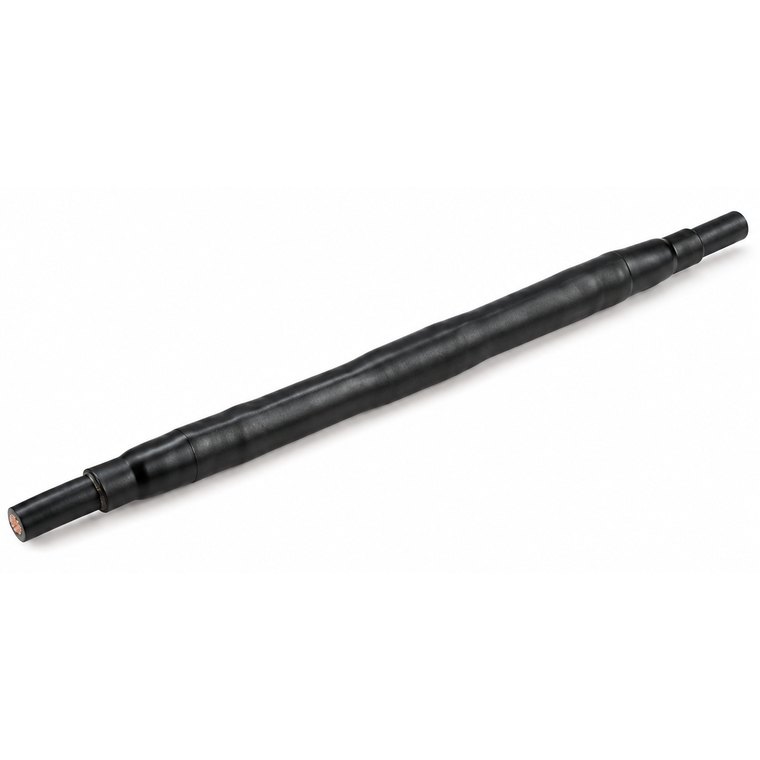
LV Accessory Compounds are high-performance polymer compounds specially developed for low-voltage cable joints, cable terminations, insulation components, and heat-shrinkable cable accessories.
Compounds used in heat-shrinkable applications must provide a combination of critical properties, including controlled shrinkage behavior, flexibility, mechanical strength, electrical insulation, thermal stability, and environmental resistance.
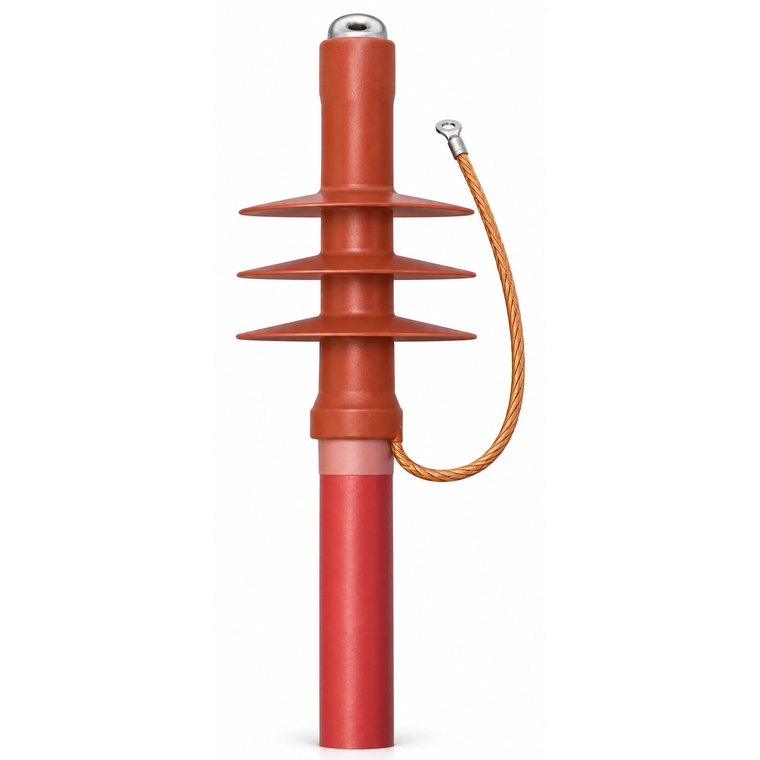
MV Accessory Compounds are high-performance polymer compounds specially developed for medium-voltage cable accessories. They can be formulated for heat-shrinkable cable joints, cable terminations, insulation components, stress-control components, and protective elements.
Medium-voltage applications require materials with high electrical insulation, dielectric strength, thermal stability, flexibility, and mechanical strength. For heat-shrinkable accessories, our formulations can provide controlled and uniform shrinkage and resistance to environmental stresses.
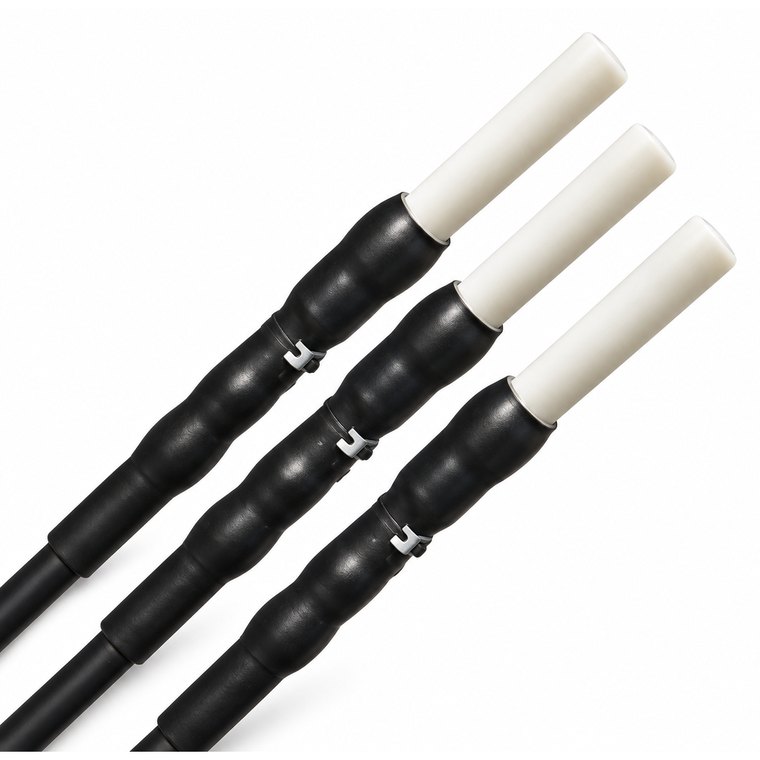
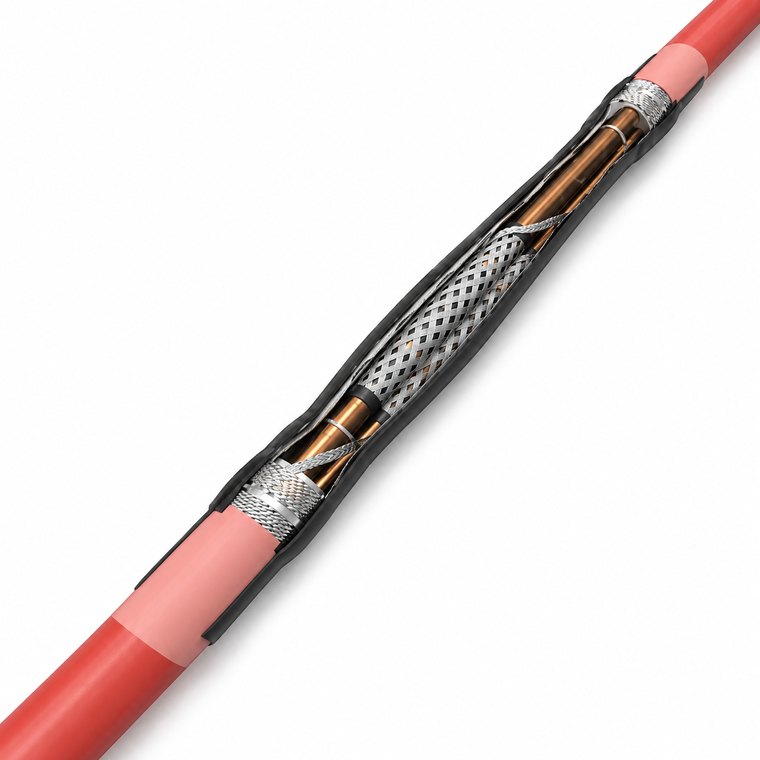
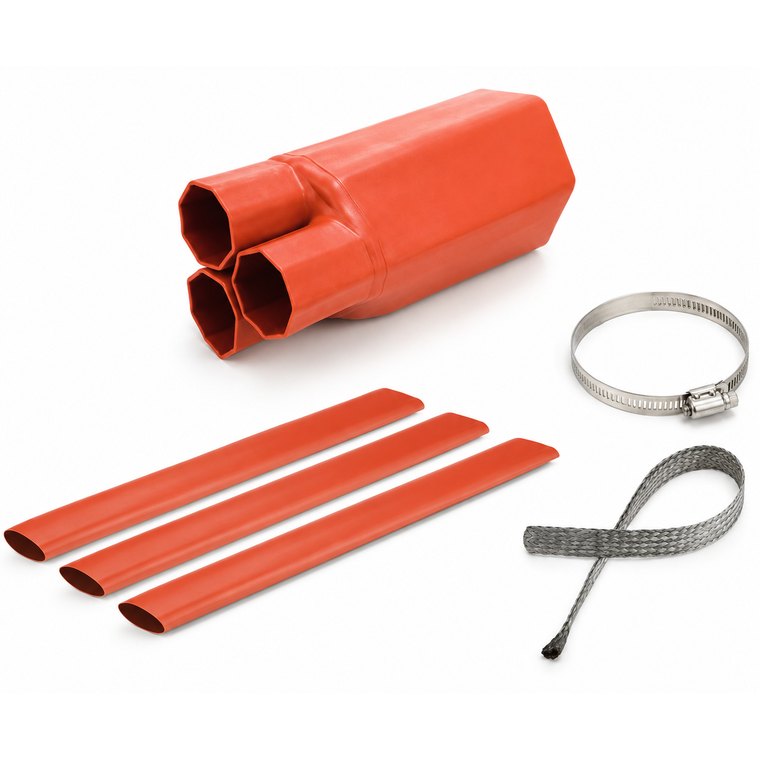
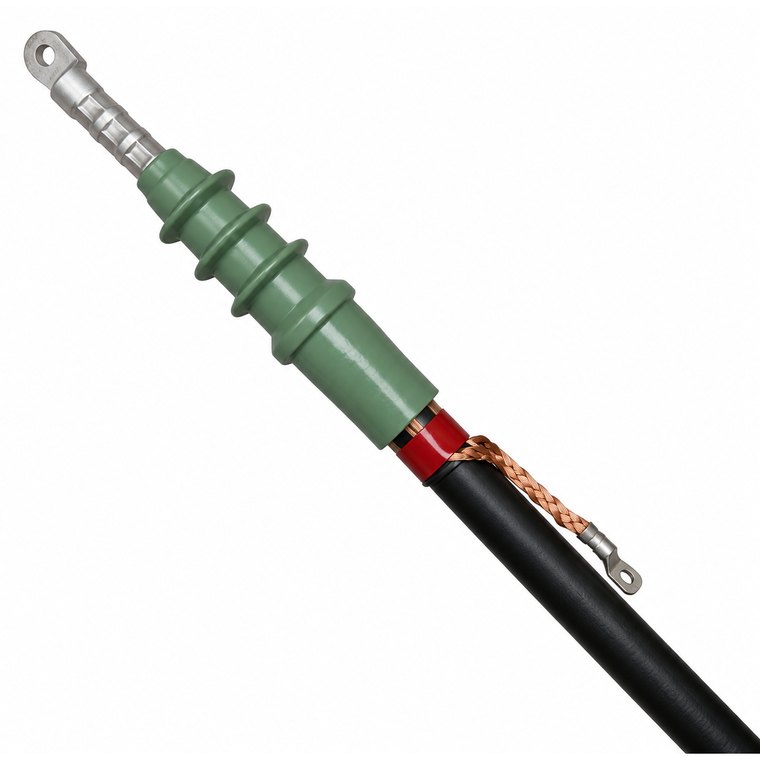
HV Accessory Compounds are high-performance polymer compounds developed for use in high-voltage cable accessories. Application-specific formulations can be developed for cable joints, cable terminations, insulation components, stress-control elements, and protective parts.
Our compounds are designed to provide reliable and consistent performance under high electrical and thermal stresses. For heat-shrinkable high-voltage accessories, specialized formulations can provide controlled shrinkage, high insulation performance, flexibility, and environmental resistance.
Request grade-specific technical data and processing guidance for your application.
Flame retardancy meets flexibility.
FR-TPU (Flame Retardant Thermoplastic Polyurethane) is a high-performance thermoplastic polyurethane compound designed to provide enhanced flame-retardant properties while maintaining the outstanding flexibility, mechanical strength and durability of TPU.
Combining excellent flexibility, high abrasion and tear resistance, chemical resistance and flame-retardant performance, FR-TPU is an ideal solution for demanding wire and cable applications where safety, durability and long-term performance are essential.
FR-TPU compounds are particularly suitable for applications requiring a combination of flame retardancy and mechanical durability. Their excellent flexibility and abrasion resistance make them suitable for cables exposed to continuous movement, bending and mechanical stress.
FR-TPU technology provides a balanced combination of flame performance, flexibility, mechanical durability and processability. Depending on the selected grade and formulation, FR-TPU compounds can be engineered to meet specific application requirements and relevant industry standards.
From demanding industrial environments to next-generation electric mobility, FR-TPU provides a reliable material solution where safety, flexibility and durability need to work together.
At CABPLAS, we develop FR-TPU compounds with a focus on consistent quality, reliable processing and application-specific performance. Our FR-TPU solutions are engineered to help cable manufacturers achieve the right balance between flame retardancy and the mechanical properties required for modern cable applications.
FR-TPU — Flexible by nature. Protected by design.
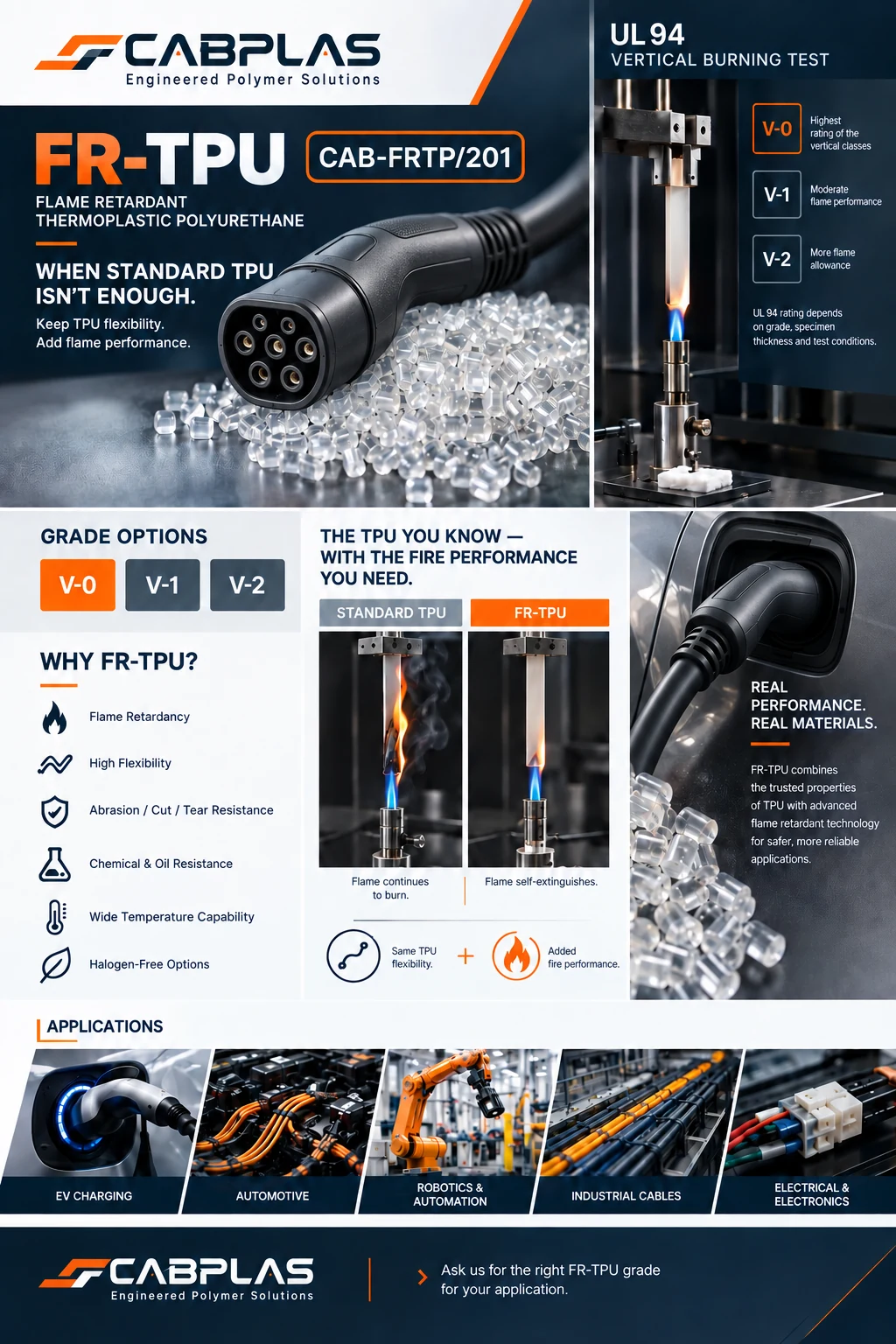
CAB-FRTP/201 · UL 94 vertical burning test
CAB-FRTP/201 keeps the flexibility, abrasion resistance and toughness that make TPU the material of choice for moving cables, and adds the flame performance those applications increasingly require. In the UL 94 vertical burning test, a standard TPU specimen keeps burning after the flame is removed; the FR-TPU specimen self-extinguishes.
Ask us for the right FR-TPU grade for your application
UL 94 classifications are specimen-based results; cable-level performance is verified per construction and the applicable standard.
Request grade-specific technical data and processing guidance for your application.
Our own special blends — additive masterbatches formulated in-house.
Select a product to open its description.
Masterbatch and Powder for Improved Flame Performance
Reduce molten-drip behavior in plastics. Support UL 94 V-0 performance.
Anti-Dripping Compounds are concentrated additive systems developed to reduce or prevent flaming-drip behavior in thermoplastics during combustion. Used together with flame-retardant systems, they help polymers meet anti-drip requirements while maintaining processability and mechanical performance. Suitable for cable, electrical & electronic and general plastic applications.
The range is available in two formats: CAB-ADM/201, an anti-dripping masterbatch for easy, accurate dosing on standard compounding and extrusion lines, and CAB-ADP/301, an anti-dripping powder for efficient low-addition use.
In the UL 94 vertical burning test, flaming drips that ignite the cotton indicator rule out a V-0 classification. Anti-dripping additives help maintain specimen integrity during flame exposure, so dripping control is a requirement for V-0 performance.

Concentrated flame-retardant solutions that raise fire performance while preserving processability and mechanical properties.
Flame Retardant Compounds are concentrated solutions designed to provide flame-retardant properties to various plastic and polymer systems. With specially formulated compositions compatible with different polymers, they enhance flame resistance while helping maintain mechanical properties and processing performance.
Decabrom Masterbatch Compounds. Decabrom Masterbatch Compounds are highly concentrated flame-retardant solutions designed to provide effective flame protection in thermoplastic and polymer applications. They offer excellent flame-retardant performance, thermal stability, and easy processing, making them suitable for various plastic, electrical, electronic, and industrial applications.
Antimony Masterbatch Compounds. Antimony Masterbatch Compounds are concentrated solutions designed to enhance flame-retardant performance in plastic and polymer systems. When used together with halogenated flame retardants, they provide a strong synergistic effect, improving flame resistance and overall fire performance. They are suitable for plastic, cable, electrical & electronic, and various industrial applications.
DECA / ATO Mix Masterbatch Compounds. DECA / ATO Mix Masterbatch Compounds are pre-blended flame-retardant solutions designed to provide efficient and consistent flame protection in polymer systems. The combination of Decabrom and Antimony Trioxide (ATO) provides a strong synergistic flame-retardant effect, helping improve fire performance while ensuring easy processing and uniform dispersion. Suitable for various plastic, cable, electrical & electronic, and industrial applications.
DECA / ATO Mix Powder. DECA / ATO Mix Powder is a powder-form flame-retardant blend containing Decabrom and Antimony Trioxide (ATO), developed to provide high flame-retardant performance in plastic and polymer systems. The synergistic effect of these components helps enhance flame resistance and fire performance while allowing easy incorporation into various thermoplastic applications. Suitable for plastic, cable, electrical & electronic, and various industrial applications.
Masterbatches that suppress metal-catalysed oxidative degradation in polymers.
Metal Deactivator Masterbatch Compounds are concentrated additive masterbatches designed to suppress metal-catalysed oxidative degradation in polymers that are in contact with copper or other metals. They help protect cable insulation and other polymer parts against thermal-oxidative ageing, improving long-term stability. Suitable for wire & cable and related applications.
Additive masterbatches that improve UV and weathering resistance.
UV Masterbatch Compounds are concentrated additive masterbatches that improve the resistance of polymers to ultraviolet radiation and weathering. By incorporating UV stabiliser systems, they help extend service life and maintain colour and mechanical properties in outdoor and exposed applications. Suitable for agriculture, construction, cable and general plastic applications.
Moisture-absorbing masterbatches that reduce moisture-related defects.
Desiccant Masterbatch Compounds are concentrated moisture-absorbing masterbatches used to reduce moisture-related defects during the processing of hygroscopic or recycled polymers. They help minimise voids, surface defects and bubbles, improving surface quality and process stability. Suitable for film, extrusion and moulding applications.
Additive masterbatches that impart water-repellent surface behaviour.
Water Repellent Masterbatch Compounds are concentrated additive masterbatches developed to impart water-repellent / hydrophobic surface behaviour to polymer products. They help reduce water absorption and improve performance in humid or wet environments. Suitable for various plastic and industrial applications.
Masterbatches carrying catalyst systems for reactions such as moisture crosslinking.
Catalyst Masterbatch Compounds are concentrated masterbatches carrying catalyst systems used to promote specific reactions such as moisture-crosslinking of polyethylene. They are designed for consistent dosing, uniform dispersion and reliable processing performance. Suitable for cable and related crosslinked-polyolefin applications.
Enhanced Thermal Stability and Long-Term Polymer Protection
Antioxidant Masterbatch is a specialized additive solution designed to protect polymers against thermal and oxidative degradation during processing and throughout their service life. By incorporating carefully selected antioxidant additives into a compatible polymer carrier, it helps maintain material stability, preserve mechanical properties, and improve the durability of plastic products.
During polymer processing, exposure to elevated temperatures, oxygen, and repeated thermal stress can initiate oxidation, leading to discoloration, changes in melt flow behavior, reduced mechanical performance, and premature material degradation. Antioxidant Masterbatch helps control these effects by reducing oxidative damage and supporting consistent material quality.
Antioxidant Masterbatch can be used in a wide range of polymer applications, depending on the carrier resin and additive formulation, including:
Antioxidant Masterbatch formulations can be customized according to the polymer type, processing conditions, required thermal stability, and end-use performance requirements. The appropriate antioxidant system and dosage depend on the specific application and should be validated through technical evaluation.
Antioxidant Masterbatch — Supporting polymer stability, processing consistency, and long-term material performance.
Request grade-specific technical data and processing guidance for any of our special blend masterbatches.
Flame-retardant masterbatches for polyolefin gas and pressure pipe systems.
Gas Pipe FR Compounds are concentrated flame-retardant masterbatches formulated for polyolefin systems used in gas and pressure pipe applications. They are designed to enhance fire performance while helping preserve the mechanical strength, long-term stability and processing behaviour required for piping. Suitable for pipe extrusion and related industrial applications.
Request grade-specific technical data and processing guidance for your application.
Masterbatches that improve polymer–filler adhesion and compatibility.
Coupling Agent Compounds are concentrated carrier systems containing coupling agents (e.g. silane-based systems) that improve adhesion and compatibility between polymers and mineral fillers or reinforcements. They help enhance mechanical properties, dispersion and filler loading. Suitable for filled and reinforced compound applications.
Request grade-specific technical data and processing guidance for your application.
Specialized rubber compound solutions for flexibility, durability, and reliable performance.
Rubber Compounds are elastomeric compounds developed for applications requiring high flexibility, mechanical strength, thermal stability, and environmental resistance.
Our formulations can be optimized according to requirements such as oil and chemical resistance, abrasion resistance, flame retardancy, low-temperature flexibility, and long-term durability.
EPDM Rubber Compounds are elastomeric compounds developed for applications requiring excellent resistance to high temperatures, ozone, UV, moisture, and demanding environmental conditions.
Our EPDM rubber compounds can be developed for cable accessories, seals and sealing components, automotive parts, industrial profiles, and various rubber components. Formulations can be optimized to provide high flexibility, mechanical strength, aging resistance, weather resistance, and long-term thermal performance.
Silicone Rubber Compounds are high-performance elastomeric compounds developed for applications requiring excellent thermal stability, flexibility, electrical insulation, and resistance to UV, ozone, and environmental conditions.
Our silicone rubber compounds can be developed for cable insulation and sheathing, cable accessories, seals and sealing components, medical parts, and various industrial applications. Formulations can be optimized according to operating temperature, flame retardancy, mechanical strength, flexibility, and electrical performance.
Neoprene Rubber Compounds are elastomeric compounds developed for applications requiring high resistance to oil, ozone, weathering, and mechanical stress.
Our neoprene rubber compounds can be developed for use in cable sheathing, cable accessories, seals, sealing components, industrial profiles, and various rubber components. Formulations can be optimized for flexibility, mechanical strength, flame retardancy, oil and chemical resistance, and long-term environmental performance.
CPE (Chlorinated Polyethylene) Compounds are elastomeric compounds primarily used in high-performance cable sheathing, offering excellent physical properties and broad resistance to fluids, solvents, and chemicals.
Our CPE compounds can be developed for applications requiring resistance to oils, hydrocarbons, fuels, and greases, together with high abrasion and impact resistance and flame performance. Depending on requirements, compounds can be optimized for operating temperatures of approximately -20 C to +105 C.
NBR (Nitrile Butadiene Rubber) Compounds are elastomeric compounds developed for applications requiring high resistance to oils, fuels, and various chemicals.
Our NBR compounds can be developed for use in cable sheathing, seals, sealing components, hoses, industrial profiles, and various rubber components. Formulations can be optimized for oil and fuel resistance, mechanical strength, abrasion resistance, flexibility, and temperature resistance.
EVA (Ethylene Vinyl Acetate) Rubber Compounds are elastomeric compounds developed for applications requiring high flexibility, good mechanical strength, thermal stability, and electrical performance.
Our EVA rubber compounds can be developed for cable insulation and sheathing, flexible cables, energy cables, industrial applications, and various rubber components. Formulations can be optimized for flexibility, mechanical strength, abrasion resistance, flame retardancy, temperature resistance, and aging performance.
Request grade-specific technical data and processing guidance for your application.
Carrier-specific filler systems tailored to the base polymer, mineral loading, process and end-use requirements.
Carrier-specific filler systems for polymer processing. Formulation direction can be tailored according to the base polymer, mineral loading, process and end-use requirements.
Mineral-filled solutions using a PP carrier system, developed to support cost-performance balance, processing consistency and application-specific formulation needs.
EVA carrier systems for applications requiring flexible processing behavior and compatibility with selected polymer formulations.
PS-based filler solutions designed for consistent dispersion and efficient incorporation into polystyrene processing systems.
LLDPE carrier systems developed for film, extrusion and other polyethylene applications where processing stability and controlled mineral incorporation are important.
POE carrier systems for specialized polymer formulations where flexibility, compatibility and application-specific processing behavior are required.
HDPE carrier systems for rigid polyethylene applications, developed to support stable processing and targeted formulation economics.
Request grade-specific technical data and processing guidance for your application.
Application-specific PVC compound solutions for cable, profile and healthcare-related applications.
Application-specific PVC compound solutions for cable, profile and healthcare-related applications, with grade suitability evaluated against the relevant processing and end-use requirements.
PVC (Polyvinyl Chloride) Compounds are thermoplastic compounds used for insulation and sheathing applications in energy, control, instrumentation, and industrial cables. They can be developed to meet different mechanical, thermal, electrical, and flame-performance requirements according to cable design and operating conditions.
Our PVC compounds can be optimized to provide electrical insulation, mechanical strength, flexibility, flame retardancy, abrasion resistance, and oil and chemical resistance.
Rigid PVC compound solutions for window profile applications, designed around stable extrusion, surface quality and application-specific formulation requirements.
PVC formulations developed for exterior profile applications where consistent extrusion and end-use requirements must be considered together.
PVC compound solutions for interior profile and skirting applications, developed for controlled processing and application-specific aesthetics and performance.
Specialized PVC compounds for healthcare-related applications. Grade selection and suitability are evaluated according to the specific application and applicable regulatory requirements.
Request grade-specific technical data and processing guidance for your application.